Retail TV Advertising: “It’s not creative if it doesn’t work.”

August 22, 2009

1960-Philco-TV-AdAs an ad agency owner, it never ceases to amaze me on what makes this business tick. In light of the worst economy in 60 years, logic would say that agencies should be pitching their ability to make the cash register ring.

Instead, any talk about getting customers through the door is obligatory at best with a lot of agencies. Why talk about results when you can drone on and on about your agency’s “award winning” TV commercials? After all, it’s how many awards an agency wins that separates one shop from next. Right?

Who’s kidding who, it’s a lot easier for agency people to wax philosophical on their “break through creative” (the most over-wrought words in advertising) than to defend their work through the prism of increased market share and higher comparative sales.

Unfortunately, too many of my colleagues have forgotten the golden rule in retail advertising:

“It’s not creative if it doesn’t work.”

And even more prefer the easy way out through the creation of advertising that “tells not sells.” You know, the kind of commercials that spend 22 seconds setting up the joke and the last 8 seconds poorly selling the product.

So the next time, you’re ad agency is enthusiastically trying to sell you on another “award winning” television campaign. Keep them honest and ask four simple questions:

  1. What is the strategy behind what you’re proposing? (Note: “because it’s such a cool idea” is not a strategy.)
  2. Why is this campaign the best use of my advertising dollars?
  3. Is there anything else we could do that would deliver a better ROI?
  4. Will this campaign increase awareness or sales? (Note: awareness is hard to measure; sales are not.)

Then, just sit back and get ready for the show; along with developing all those award-winning commercials – many agencies have become quite adept at the lost art of tap dancing.

Share


Retailers: TV is More Engaging than Internet and Mobile

August 21, 2009

Picture for Post #11Although it makes common sense, it’s still nice to see a study that confirms what a lot of us already knew:  For retailers especially, television presents a more effective commercial environment than the Internet or mobile devices. 

A new report from the research firm NeuroFocus found that TV earns high marks for emotional engagement, message recall and intent to purchase.  While on the other hand, viewers of small-screen media (Internet and mobile) found the ad experience to be less immersive and not nearly as engaging as TV. 

“Emotional response appears to be tied to the way people use different media platforms,” said Clay Collier, Cable & Telecommunications Association’s VP of Research.

He adds, “TV is particulary good at striking an emotional cord and conveying a sense of novelty. If you want to draw someone in and create an immersive environment, TV is a better fit.”

“On the small screen (mobile devices), certain emotional triggers – facial expressions, for example – are somewhat undermined,” said Clay.

(Somewhat undermined? On a three inch cell phone screen, you’d be lucky enough to discern a face, let alone facial expressions.)

The study also found that TV and Mobile ads were particularly effective at prompting a sale.  Not so for Internet ads, which appear to require repeated exposure before eliciting a consumer response.

On the emotional engagement scale, Internet ads came in last by a wide margin. 

“It stands to reason that people who are less emotionally invested in your ad may be less likely to buy your product,” said Tim Brooks, a former Lifetime Network Research Director.

I told you this was common sense … 


Share


A Checklist for Better Retail TV Advertising

August 19, 2009

Fact: Nobody woke up this morning waiting to see your TV commercial.

Challenge: With thousands of messages fighting every day for consumers’ attention, why should they pay attention to yours? 

checklistThe Checklist

1)     Is your commercial “benefit” driven?

  • Your commercial must provide consumers with “real” benefits.  Hint: “Family owned and operated” is not one, nor are uncorroborated claims like “We won’t be undersold.”
  • Remember it’s not what you want to say, but what your customers want to hear that’s important.

 2)     Does your commercial help differentiate your business from the competition?

  • If you’re not unique on some dimension, you’re just a commodity. And commodities live and die on price only.
  • Blending in will kill your margins and eventually your business model.  Standing out ensures survival.

 3)     Is your commercial relevant to your target audience? 

  • TV advertising is not fairy dust … it can’t sell a product or service that consumers don’t want at prices they’re not willing to pay. TV advertising guarantees an audience – not success.

 4)     Is your commercial focused?

  • All display is no display.
  • When possible, boil the message down to one or two points of distinction.
  • A good commercial is designed to engage and persuade, not serve as an owner’s manual.

 5)     Does your commercial support your brand position?

  • Your commercial should reinforce the way you want consumers to think and feel about your brand.
  • It’s not always what you say, but how you say it (tone & manner) that often separates retail brands.

 6)     Does your commercial move prospects to the next level?

  • If it doesn’t then you don’t have a retail commercial, period.
  • Decide what action you want prospects to take (call for an appointment, visit your website, shop your stores, etc.) and develop your commercial with that focus in mind.

Share


Retailers: Think Twice Before Cutting Back Your Ad Spending

August 18, 2009

Picture for Blog #9A new study by ThinkVine, a Cincinnati analytics firm, offers evidence that cutting out ad spending during a recession can have harmful consequences.  

The firm that does predictive media modeling for marketers such as PepsiCo, and Colgate-Palmolive, found that although companies can usually get away with cutting media spending in the short term; cutbacks over 16 weeks can start to erode sales volume. 

The firm analyzed the effects of turning off all advertising entirely for a year on one unnamed brand.  It then studied the effects of turning it back on the next year at prior levels.  Here’s what they found: 

  • For about 16 weeks, sales volume was about the same. 
  • By the end of year one, however, sales volume was about 20% lower without advertising than with it. 
  • Turning the advertising back on in year two, reversed the sales decline as the brand began growing again at the same rate before the advertising was stopped. 
  • However, the advertising was not able to close the gap in sales compared with what it would have achieved had it maintained media spending for both years. 

Different brands respond differently to media cuts, but for many – getting back sales and share lost from cutting budgets can be a lengthy and an expensive process. 

ThinkVine CEO, Damon Ragusa, said it best:

“The cost of getting back what you lose is often greater than the savings of not advertising.”


Share


Are TV Ads Still Effective for Retailers?

August 17, 2009

50s TV commercialYou bet they are!

A study of 388 case histories by the Advertising Research Foundation (ARF) found that TV is not only effective, but it is possibly even more effective when it comes to increasing sales.

In today’s complicated world “TV ads help simplify the buying decision, said Joel Robinson,” ARF’s Chief Research Officer.

People want to zone out and watch TV and relax and let the communications wash over them. TV is an extension of the brand experience.”

Robinson said, the findings concluded that “units sold numbers increased as a result of increased TV impressions.” He added, “When you see it across 388 case histories, I think you’ve got to believe it.”

The report titled, Empirical Evidence of TV Advertising Effectiveness was an analysis of case histories gathered from seven different research agencies from 1990 – 2008.

The study also concluded that TV was #1 in terms of raising brand awareness.

Share


3 Basic Elements to an Effective Retail TV Commercial

August 14, 2009

TV Call To Action for Post #8TV advertising can be the most effective form of advertising you can use to grow your retail chain – or it can be colossal waste of money.  
You decide. 

Don’t depend on your ad agency to tell you.  A lot of them are too busy winning awards with your money to worry about what’s effective or not. 

 It’s up to you to know the difference between commercials that win acclaim and those that win customers.  

 To help out, here’s s are some basic (but essential) elements that every retail TV commercial should possess.

 1)      Call to Action:  Why advertise if you’re not providing consumers with tangible reasons to shop your store?  The key word here is tangible. Stay away from generic platitudes like “low prices” and “great selection.”  Or other obvious claims like the one I saw the other day for a fence company, where they proudly advertised: “We build dependable fences.” As if there was a market out there for undependable ones.   

 2)      A Brand Promise:  A lot of retailers (and some ad agencies) think that a strong call to action and a branding message don’t mix well in a 15 or 30-second TV commercial – you have to choose one or another.  On the contrary, it’s only when both the brand promise and the offer coexist, that you have the makings for an effective TV commercial.  Would you rather have a .99 cent hamburger from a no name burger joint or a .99 cent Big Mac from one of the most recognizable brand names in the world?  Without a brand promise, your price and item commercial will fall flat.

 3)      Consistency:  Al Ries, probably the nation’s foremost authority on retail marketing said it best:

“Brand building is boring work. What works best is absolute consistency over an extended period of time.”

Find something that works and stick with it. Just ask BMW who has stayed the course since 1975 with “The Ultimate Driving Machine”.  Or how about Maxwell House Coffee’s 94-year history with its “Good to the last drop” positioning?   Short and simple – consumers reward consistency.

Share


Attention Retailers: TV Still Leads Internet

August 14, 2009

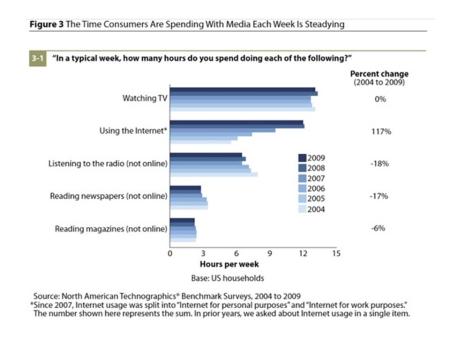
A Forrester Research study reported in Mediaweek recently has found the “heady days of steep upticks in Internet use appear to be over.”

After experiencing steady growth from 2004 – 2007, time spent online has plateauted in 2008 at about 12-hours a week, unchanged from the year before.

Television still leads the Internet and every other medium in the study with an average of 13 hours of viewing a week.

Mediaweek also noted that over the 5-year period in which the Internet showed its greatest growth, TV remained unchanged as Internet usage came at the expense of other media.

In that period, time spent with radio declined by 18%, newspaper time fell by 17% and magazines lost 6%.

Graph for Post #7

Share


Retail Television Advertising Still Makes Sense

August 13, 2009

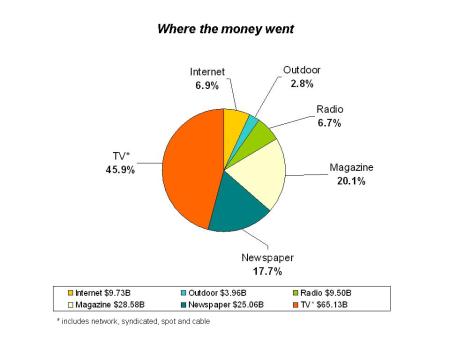
Why do retail advertisers continue to spend 46% of their ad budgets on television advertising? And only 7% on the Internet?

Graph for Post 5

It makes perfect sense to me. TV commands such a lion share of the nation’s media spending because it deserves to. After all is said and done, it comes down to results. No amount of wishful thinking can change the fact that TV advertising produces better “brand building” results than any other media platform, including the Internet.

Don’t know about you, but I could of swore I saw the Geico Gecko and that creepy, but effective Burger king character for the first time on TV.

With that said, the Internet is a powerful complement to traditional mass media when it comes to providing consumers with in-depth information on a product or service. It’s weakness; however, is its inability to transform a brand promise into a brand personality. For that – nothing beats the sight, sound and action of a 30-second television commercial.

TV is not dead and it’s not dying. There’s too much evidence out there for anyone with slightest bit of intellectual honesty to deny.

You don’t have to look any further than online video consumption to realize that television is more than holding its own in the digital age. Are people really abandoning their 50 inch plasmas in favor of viewing downloaded video content onto their laptops and cell phones? Or are they spending all their time on YouTube watching one of the thousands of insipid videos submitted each and every day? Perhaps some are, but it’s far from being a groundswell – even among the young.

According to the latest Nielsen Media Research Study on media usage, 18-24 year-olds are watching just under 5 ½ minutes of online video a day versus 3 ½ hours of TV daily.

As Andy Donchin, the director of national broadcast for Carat, the largest media buying service in the world put it:

“traditional media is still very strong and a great influencer. You need to get immersed in digital, but traditional media is still doing the heavy lifting.”

I couldn’t have said better myself…

Share


Retail Chains Benefit from “The Recency Theory”

August 12, 2009

retail“Spend your media dollars as efficiently as possible … only advertise when you have the greatest chance for success.”

If you’re responsible for the television advertising budget for a small to medium size retail chain and you’re not employing The Recency Theory into your media strategy – then keep reading.

Don’t worry; I won’t bore you to death with some technical dissertation. Although this concept may be different from what you’re doing now, it’s really more about common sense than anything else.

The Recency Theory states: Ads work best when people are ready to buy. Pretty simple, huh? It also favors reach over frequency, which is especially beneficial for those chains struggling with limited ad budgets.

Under The Recency Theory, commercials are bought to target consumers as close to the time of decision as possible. The closer your message gets to the time of decision – the greater the impact. On the other hand, the influence of the ad exposure diminishes the further away from the time of decision.

For example, an Olive Garden commercial is more effective right before dinner time than in the early morning. Logic dictates that Joe is going to be more receptive to an All-You-Can-Eat Pasta offer when he’s hungry for dinner than right before his morning coffee.

Under The Recency Theory, consumers have a role in making the advertising work.

  • The advertising itself did not get Joe to perk-up to the offer. The hunger in the pit of his stomach did.
  •  The TV advertising simply reminded Joe how hungry he was and at the same time presented him with a timely offer.
  • In fact, Joe may have been exposed to multiple Olive Garden commercials throughout other time periods, but hardly noticed them because he was not thinking about food at the time.

With The Recency Theory you only advertise when you have the greatest chance for success. You choose reach over frequency. In the case above, one strategically placed commercial at dinner time trumps two or three commercials placed in the morning hours.

It’s all about influencing the purchasing decision while spending your media dollars as efficiently as possible. The recency theory requires retail chains (and their agencies) to look beyond traditional measuring metrics and to rely on something that is hard to quantify on a flowchart: Common Sense!

Share


TV is Still the Biggest Cannon for Retail Marketers

August 11, 2009

artygun8TV is still the biggest cannon in the land” That’s what Steve Boal, the CEO of Coupons.com said when he launched his first TV campaign in the company’s 11-year history on August 1st.

The campaign features three humorous commercials that remind recession-strapped consumers that Coupons.com is the place to “Click. Print. Save.”

Based on testing with the company’s subsidiary online brands, Boal found that TV advertising proved “extremely cost effective.” (Imagine that.)  He even went a step further and credited the TV initiatives for “creating more brand affinity than their online initiatives.” (How can that be?)

“The response rate and the rate of return of those people who found out about us on TV was slightly higher than those who found out about us on the Internet,” said Boal. (Whoa! I’m speechless…this can’t be happening.)

Actually, it’s been happening for the last half century. Start off with a good product or service that people want, add in a dash of creativity, mix in the ultimate mass media platform and presto….you have the perfect recipe for what every advertiser is really searching for: Results.

Nothing takes a brand to the next level like TV. 

Share