Retail TV and Online Advertising Work Better Together

August 25, 2009

For the first time, the effectiveness of using TV and online advertising in tandem has been examined in depth.  A pioneering new study conducted by Q Media Research in the UK has shown that using TV and online together is significantly more effective for advertisers than using either in isolation. 

The study concluded that using the two media together does provide a very powerful combination across the whole process … from telling consumers about a brand they never heard of before … to helping them decide on which brands are more relevant to them.

Although it’s not always the case, the relationship does tend to flow from TV to online with TV sparking initial interest, awareness and “talkability” about a brand.   With online providing consumers with the additional information they need to aid in decision making and purchase.

This particular combination is very powerful in raising purchase consideration with retail TV advertising generally starting the process and online completing it.

 Other key findings from the study include:

  •  Using TV advertising and online together results in 47% more positive feelings about a brand than using either in isolation. 
  • The likelihood of buying or using a product increases by more than 50% when TV and online are used together. 
  • 48% of the sample group of 3,000 respondents watched TV while online, most days. Going online was second only to eating for activities that people do while the TV is on. 
  • The findings reinforce the need to ensure creative synergy between TV and online advertising:
    • TV and Online campaigns need to have a consistent theme/message.
    • The strength of each media needs to be maximized (TV for excitement and impact. Online for interaction and personalized engagement).
    • There needs to be a high level of visual synergy between the two mediums.
    • Rather than use online as a reach medium, it should be used to target those who have already seen the TV advertising as a way of extending the campaign message.

Graph for Post #15

Guy Phillipson, CEO of the Internet Advertising Bureau, had this to say:

“This important study delivers clear evidence of just how powerful and effective the TV and online combination is. In all the categories we tested, the results were very positive for both ‘soft’ brand measures and ‘hard’ purchase intent scores.”

Click here to read entire study.


Share


July’s Top 10 Most Memorable New Retail TV Ads

August 24, 2009

So, what good is a retail TV commercial, if a day later you can’t recall who the commercial was for?  It’s not enough to entertain the masses; your commercial must have above average brand recall if you want to make the cash register ring.

The following companies get that.  And that’s why they were named as Nielsen’s Top 10 Most Memorable Ads for July 2009. 

The list is based on the top recall scores of new commercials that ran in July.  The Recall Score is the percentage of TV viewers who can recall the brand of an ad within 24 hours they were exposed to it during the normal course of viewing TV.  These scores are then indexed against the mean score of all new ads during the period (Recall Index).

A score of 100 equals average.  For example, with a Recall Index of 245, the top ranked Pizza Hut ad has proven to be over 2.4 times more memorable than the average new commercial that aired in the month of July.

Now that I got that out of the way … sit back and enjoy! 

And don’t forget to come back next month to see who made the August list …

Pizza Hut: Index 245

Gatorade: Index 234

Old Navy: Index 226

KFC: Index 224

Progressive: Index 219

Kool-Aid: Index 211

McDonald’s: Index 206

Pizza Hut: Index 196

Skittles: Index 188

Hallmark: Index 187


Share


The Gap replaces retail TV budget with Web and Social Media

August 23, 2009

Picture for Post #14After reading about The Gap’s new online advertising campaign, I was left yearning for the days where retail advertising had a more concrete purpose – like maybe selling something.  


I thought agencies were about developing engaging strategies to increase sales and market share.  And I thought those who were responsible for such strategies had some accountability when it came to delivering results.

If the new Gap strategy is any indication – my thinking may have been wrong.  

The new ad campaign from The Gap, titled “Born to Fit,” includes no TV commercials instead, for the first time in the retailer’s history, The TV budget has been replaced with Web and Social Media – more specifically Facebook.  Print, cinema and outdoor ads have been developed to drive consumers to the campaign’s Facebook page.

Always open to new ideas … I eagerly logged onto The Gap’s Facebook page. After a few seconds, I clicked onto the video section, expecting to hear why people like wearing Gap jeans.  Instead I was treated to a short video from seven so-called celebrity “icons” – each one yammering on and on about the complexities of their “intriguing” lives.  

As they speak, each “icon” (and I use this world loosely) is sitting on a stool against a white background while the camera – occasionally – pans down to the Gap jeans they are wearing.  By the time I watched all of them, I wasn’t sure if The Gap wanted me to buy a pair of jeans or question my place in the universe.

Julie Channing, senior account director with The Gap’s digital agency explains the strategy this way, “We were really looking to reach out to fashionistas and influence audiences to start a conversation about how Gap has built this line of denim from the ground up.”

Really?  So, consumers are going to visit a Facebook page and soon after begin conversing with friends and family about the development of a new brand of blue jeans?

Channing goes on to say, The Gap had set no numerical benchmarks to determine success in the campaign, but rather would look at “how much consumers interact with the brand” to gauge ROI.

So, let me make sure I understand this – The Gap’s ROI objective is to count how many people are talking about jeans, not how many are buying them.

Don’t you just love how some companies are using social media?


Share


Retail TV Advertising: “It’s not creative if it doesn’t work.”

August 22, 2009

1960-Philco-TV-AdAs an ad agency owner, it never ceases to amaze me on what makes this business tick. In light of the worst economy in 60 years, logic would say that agencies should be pitching their ability to make the cash register ring.
Instead, any talk about getting customers through the door is obligatory at best with a lot of agencies. Why talk about results when you can drone on and on about your agency’s “award winning” TV commercials? After all, it’s how many awards an agency wins that separates one shop from next. Right?

Who’s kidding who, it’s a lot easier for agency people to wax philosophical on their “break through creative” (the most over-wrought words in advertising) than to defend their work through the prism of increased market share and higher comparative sales.

Unfortunately, too many of my colleagues have forgotten the golden rule in retail advertising:

“It’s not creative if it doesn’t work.”

And even more prefer the easy way out through the creation of advertising that “tells not sells.” You know, the kind of commercials that spend 22 seconds setting up the joke and the last 8 seconds poorly selling the product.

So the next time, you’re ad agency is enthusiastically trying to sell you on another “award winning” television campaign. Keep them honest and ask four simple questions:

  1. What is the strategy behind what you’re proposing? (Note: “because it’s such a cool idea” is not a strategy.)
  2. Why is this campaign the best use of my advertising dollars?
  3. Is there anything else we could do that would deliver a better ROI?
  4. Will this campaign increase awareness or sales? (Note: awareness is hard to measure; sales are not.)

Then, just sit back and get ready for the show; along with developing all those award-winning commercials – many agencies have become quite adept at the lost art of tap dancing.

Share


Retailers: TV is More Engaging than Internet and Mobile

August 21, 2009

Picture for Post #11Although it makes common sense, it’s still nice to see a study that confirms what a lot of us already knew:  For retailers especially, television presents a more effective commercial environment than the Internet or mobile devices. 

A new report from the research firm NeuroFocus found that TV earns high marks for emotional engagement, message recall and intent to purchase.  While on the other hand, viewers of small-screen media (Internet and mobile) found the ad experience to be less immersive and not nearly as engaging as TV. 

“Emotional response appears to be tied to the way people use different media platforms,” said Clay Collier, Cable & Telecommunications Association’s VP of Research.

He adds, “TV is particulary good at striking an emotional cord and conveying a sense of novelty. If you want to draw someone in and create an immersive environment, TV is a better fit.”

“On the small screen (mobile devices), certain emotional triggers – facial expressions, for example – are somewhat undermined,” said Clay.

(Somewhat undermined? On a three inch cell phone screen, you’d be lucky enough to discern a face, let alone facial expressions.)

The study also found that TV and Mobile ads were particularly effective at prompting a sale.  Not so for Internet ads, which appear to require repeated exposure before eliciting a consumer response.

On the emotional engagement scale, Internet ads came in last by a wide margin. 

“It stands to reason that people who are less emotionally invested in your ad may be less likely to buy your product,” said Tim Brooks, a former Lifetime Network Research Director.

I told you this was common sense … 


Share


A Checklist for Better Retail TV Advertising

August 19, 2009

Fact: Nobody woke up this morning waiting to see your TV commercial.

Challenge: With thousands of messages fighting every day for consumers’ attention, why should they pay attention to yours? 

checklistThe Checklist

1)     Is your commercial “benefit” driven?

  • Your commercial must provide consumers with “real” benefits.  Hint: “Family owned and operated” is not one, nor are uncorroborated claims like “We won’t be undersold.”
  • Remember it’s not what you want to say, but what your customers want to hear that’s important.

 2)     Does your commercial help differentiate your business from the competition?

  • If you’re not unique on some dimension, you’re just a commodity. And commodities live and die on price only.
  • Blending in will kill your margins and eventually your business model.  Standing out ensures survival.

 3)     Is your commercial relevant to your target audience? 

  • TV advertising is not fairy dust … it can’t sell a product or service that consumers don’t want at prices they’re not willing to pay. TV advertising guarantees an audience – not success.

 4)     Is your commercial focused?

  • All display is no display.
  • When possible, boil the message down to one or two points of distinction.
  • A good commercial is designed to engage and persuade, not serve as an owner’s manual.

 5)     Does your commercial support your brand position?

  • Your commercial should reinforce the way you want consumers to think and feel about your brand.
  • It’s not always what you say, but how you say it (tone & manner) that often separates retail brands.

 6)     Does your commercial move prospects to the next level?

  • If it doesn’t then you don’t have a retail commercial, period.
  • Decide what action you want prospects to take (call for an appointment, visit your website, shop your stores, etc.) and develop your commercial with that focus in mind.

Share


Retailers: Think Twice Before Cutting Back Your Ad Spending

August 18, 2009

Picture for Blog #9A new study by ThinkVine, a Cincinnati analytics firm, offers evidence that cutting out ad spending during a recession can have harmful consequences.  

The firm that does predictive media modeling for marketers such as PepsiCo, and Colgate-Palmolive, found that although companies can usually get away with cutting media spending in the short term; cutbacks over 16 weeks can start to erode sales volume. 

The firm analyzed the effects of turning off all advertising entirely for a year on one unnamed brand.  It then studied the effects of turning it back on the next year at prior levels.  Here’s what they found: 

  • For about 16 weeks, sales volume was about the same. 
  • By the end of year one, however, sales volume was about 20% lower without advertising than with it. 
  • Turning the advertising back on in year two, reversed the sales decline as the brand began growing again at the same rate before the advertising was stopped. 
  • However, the advertising was not able to close the gap in sales compared with what it would have achieved had it maintained media spending for both years. 

Different brands respond differently to media cuts, but for many – getting back sales and share lost from cutting budgets can be a lengthy and an expensive process. 

ThinkVine CEO, Damon Ragusa, said it best:

“The cost of getting back what you lose is often greater than the savings of not advertising.”


Share


Are TV Ads Still Effective for Retailers?

August 17, 2009

50s TV commercialYou bet they are!

A study of 388 case histories by the Advertising Research Foundation (ARF) found that TV is not only effective, but it is possibly even more effective when it comes to increasing sales.

In today’s complicated world “TV ads help simplify the buying decision, said Joel Robinson,” ARF’s Chief Research Officer.

People want to zone out and watch TV and relax and let the communications wash over them. TV is an extension of the brand experience.”

Robinson said, the findings concluded that “units sold numbers increased as a result of increased TV impressions.” He added, “When you see it across 388 case histories, I think you’ve got to believe it.”

The report titled, Empirical Evidence of TV Advertising Effectiveness was an analysis of case histories gathered from seven different research agencies from 1990 – 2008.

The study also concluded that TV was #1 in terms of raising brand awareness.

Share


3 Basic Elements to an Effective Retail TV Commercial

August 14, 2009

TV Call To Action for Post #8TV advertising can be the most effective form of advertising you can use to grow your retail chain – or it can be colossal waste of money.  
You decide. 

Don’t depend on your ad agency to tell you.  A lot of them are too busy winning awards with your money to worry about what’s effective or not. 

 It’s up to you to know the difference between commercials that win acclaim and those that win customers.  

 To help out, here’s s are some basic (but essential) elements that every retail TV commercial should possess.

 1)      Call to Action:  Why advertise if you’re not providing consumers with tangible reasons to shop your store?  The key word here is tangible. Stay away from generic platitudes like “low prices” and “great selection.”  Or other obvious claims like the one I saw the other day for a fence company, where they proudly advertised: “We build dependable fences.” As if there was a market out there for undependable ones.   

 2)      A Brand Promise:  A lot of retailers (and some ad agencies) think that a strong call to action and a branding message don’t mix well in a 15 or 30-second TV commercial – you have to choose one or another.  On the contrary, it’s only when both the brand promise and the offer coexist, that you have the makings for an effective TV commercial.  Would you rather have a .99 cent hamburger from a no name burger joint or a .99 cent Big Mac from one of the most recognizable brand names in the world?  Without a brand promise, your price and item commercial will fall flat.

 3)      Consistency:  Al Ries, probably the nation’s foremost authority on retail marketing said it best:

“Brand building is boring work. What works best is absolute consistency over an extended period of time.”

Find something that works and stick with it. Just ask BMW who has stayed the course since 1975 with “The Ultimate Driving Machine”.  Or how about Maxwell House Coffee’s 94-year history with its “Good to the last drop” positioning?   Short and simple – consumers reward consistency.

Share


Attention Retailers: TV Still Leads Internet

August 14, 2009

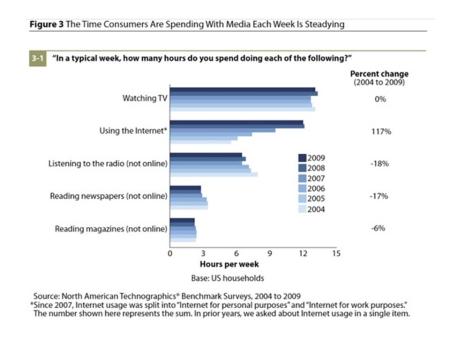
A Forrester Research study reported in Mediaweek recently has found the “heady days of steep upticks in Internet use appear to be over.”

After experiencing steady growth from 2004 – 2007, time spent online has plateauted in 2008 at about 12-hours a week, unchanged from the year before.

Television still leads the Internet and every other medium in the study with an average of 13 hours of viewing a week.

Mediaweek also noted that over the 5-year period in which the Internet showed its greatest growth, TV remained unchanged as Internet usage came at the expense of other media.

In that period, time spent with radio declined by 18%, newspaper time fell by 17% and magazines lost 6%.

Graph for Post #7

Share