Even with 86% of all movie goers venturing online everyday, most first learn of new movies the old-fashioned way: TV Commercials and in-theater trailers. No, not banner ads, not YouTube, not even Twitter polled higher than television.
Out of 3,850 movie goers who were surveyed – 73% said that they first gain awareness of new releases from TV commercials, followed by 70% from in-theater trailers.
Word-of-mouth followed at 46%, and the Internet at 44%.
What makes these numbers even more interesting is that 73% of the movie goers surveyed use social networking sites.
Good news for the much maligned TV industry and not so good news for those who would have us believe that the Internet and social media are just a tweet away from replacing traditional advertising.
The latest Three Screen Report from Nielsen finds there is again another jump in viewing done over the Internet. And to the surprise of some, traditional television viewing also continues to grow. However, the report notes a slight decrease for watching video on mobile devices.
“Although we have seen the computer and mobile phone screens taking on a significant role, their emergence has not been at the cost of TV viewership,” Nielsen’s Jim O’Hara commented. “The entire media universe is expanding so consumers are choosing to add elements to their media experience, rather than to replace them.”
In the second quarter of 2009, the monthly time spent watching TV in the home by each user reached 141 hours and 3 minutes, up from 139:00 a year ago.
People who watch video on the Internet averaged 3 hours and 11 minutes compared to 2:02 last year.
However, the monthly time spent watching video on mobile phones was actually lower than a year ago … down from 3 hours and 37 minutes to 3:15.
Is it any surprise that major retailers still turn to traditional TV to reach the masses? People spend more time with television in just two days than they spend all month long watching video on the Internet and mobile phones combined.
And when it comes to critical mass, TV continues to lead the way in a big way. While Internet and mobile viewing are showing growth over previous years, numbers that do so are still relatively small, especially for mobile viewing.
Nielsen finds that 284.4 million Americans watched some TV in their homes during the second quarter. Less than half of them (about 134 million) watched some video on the Internet, while only 15.3 million watched video on mobile phones.
Music, in my opinion, is one of the most powerful yet underutilized tools in advertising.
Anyone who remembers the mid-70s also remembers:
Two all-beef patties, special sauce, lettuce, cheese, pickles, onions on a Sesame Seed Bun!!
Thirty years later I can still hum this old McDonald’s commercial. Times have changed, and trends in advertising music have definitely changed, but music’s role in advertising is as relevant as ever.
The biggest problem in today’s jingles is executions that push TOO HARD to make the viewer feel a certain way about the brand. Watching TV the other night, I saw a commercial for a local carpet store. At the end, a singer belts out gleefully:
JB factory carpets … the biggest … the best … always the lowest price!
I have to question whether I believe the singer’s sincerity. Is she really that happy about JB’s selection of fine carpets? Doubtful. And neither are the viewers. It’s the classic mistake of an advertiser talking about themselves, rather than addressing the viewers wants from the viewer’s point of view. Or maybe it’s the trite use of “biggest and best” … which ranks right up there with other homogenous phrases like “we won’t be undersold.”
True, the old McDonalds piece is a list of what you get on a burger. But it had charm and invited viewers to participate in seeing whether or not they could remember the list. And most importantly, the singers never hit you over the head with a refrain of “limited time only.”
Like many jingles in the 80s, the music painted a happy vibe that viewers associated with the brand. Remember Dr. Pepper’s “I’m a pepper, you’re a pepper”? And Toyota’s “I love what you do for me? Major advertisers haven’t forgotten how music can build brands …the executions have simply evolved.
Ba da ba-ba-ba … I’m Lovin’ It.
Indeed, I am. Here, McDonalds does it again. The music (and singers) establish an emotional connection with the listener, letting the Voice Over do the selling. The overall result is a commercial that reminds customers that McDonalds is more than just a value menu – but an experience you WANT to have.
Of course, there are times when the singer/music has to contribute a little more muscle within the message. Like singing the phone number for example. Just make sure the melody isn’t overly sappy if the lyrics are little more than a set of digits.
The music in this commercial humorously plugs the word “Free” 9 times within the span of 15 seconds. This is a perfect example of music conveying a very pointed message.
Here, a musical sting at the end of the spot reinforces the phone number. This is a more aggressive example of using music to achieve a very specific communication goal.
Yes, 15-second TV commercials are a wonderful tool for building media frequency. In fact, I’ve been a big proponent of them for years. And having been involved in the creation of hundreds of them, I can tell you they’re harder than 30s to pull off.
In developing the “creative idea,” focus on scenarios and situations that viewers can understand quickly. If they’re spending the entire commercial trying to “figure things out,” they’re not listening to your advertising message.
Since time is against you, it’s even more important to reinforce your brand along with the message. Consider finding ways to play up your brand’s colors … finding unexpected ways of integrating the logo … or dramatic moments that illustrate your point succinctly.
In short, things that will stick with the viewer long after the commercial has ended.
Above all, PACE yourself. Make sure the message is clear from the beginning because you won’t have the time to repeat everything. Most 15-second commercials feel like 30s that were crammed into half the time. If your pace is too quick, all will be lost.
Below are 3 examples, each using a different technique. All are unique in their own way. Yet all establish the premise immediately and pace themselves carefully.
In this commercial for one of our financial services clients, we used the entire span of 15 seconds to take the viewer on a visual journey ending up at an unexpected visual element that reinforces the client’s brand.
Here, multiple cuts and scenes make this 15-second spot seem longer than 15 seconds. At the end, the brand is represented by its people.
In this more recent commercial for the same client, the actor delivers lines directly to camera in a simple monologue format – while the “visual surprise” reveals itself in the window behind her.
I’ll begin by stating the obvious: not everybody has the ad budget of a Fortune 500 company. But that doesn’t mean your creative can’t compete on a national level. You just have to make your production money work harder.
Should you opt for an animated logo treatment? Custom music track? Film instead of video? A big name talent? You DON’T have to use them all to give your commercial serious creative firepower. They key is knowing what to splurge on.
By spending your money on one or two pricier components, the rest of your commercial production is elevated to a new level. Here are some examples where one or two splurges gave the TV creative national-caliber impact without a national-caliber budget.
Here, the storefront footage already existed. All we did was resize it and add quotation marks, which was VERY inexpensive. However, we needed a special voice over talent to bring the commercial to life. We opted for Tom Sharpe, for his widely recognized voice and unique style of humor. He was the only expensive component (10 times the cost of your average voice over talent) but well worth the expense.
Here, the custom music track and the animated logo treatment were the most expensive items (about $7,000 combined). However, these elements were used again and again in future commercials keeping long-term production costs down while keeping production values up.
Creativity in advertising should be anything but formulaic. A good idea, powerful visuals, a great voice over talent and a strong script will go a long way.
However, there’s something to be said for structure. Notice I said “structure” and not “formula.” The process demonstrated here shows how structuring the message can help viewers retain the message.
While this example shows the beginning, the middle, and the end of a retail TV commercial that communicates successfully, it’s important to note that variables can shift based on the complexity and amount of information.
1) Tell them what you’re going to tell them.
Start by telling your customers the “news.” If the commercial is about a special sale, tell them what it is. Better yet, find a hook people can remember.
EXAMPLE:
VO: At Florida Leather Gallery, think FREE times THREE! …
2) Tell them.
Now add the details. Reference any specific product shots, prices or particular offers. In this segment, the price/offer statement should be featured.
VO: … For a limited time, get free delivery, 2 full years free financing, and we’ll even pay your sales tax!
(Onscreen, a viewer sees graphics that coincide with the voice over and further support the offer):
1. FREE / Free delivery
2. FREE / Two years free financing
3. FREE / We’ll pay your sales tax
3) Tell them what you told them.
You’re running out of time, so focus on restating the sale name /hook/offer so they the main message stays with them.
VO: What are you waiting for! Think FREE, times THREE!
MUSIC/SINGER: Florida Leather Gallery!
A good structure will keep your message from getting confusing or convoluted. It’ll also keep you disciplined in making sure your message works within the small window of a 30-second TV commercial (or 15 seconds, as with the example above.)
Graphics are a great way of supporting your advertising message. But if they’re not handled carefully, they’ll hurt the clarity of your commercial rather than enhancing it. Here are a few things to consider when adding prices, offers and logos:
1) Consider Letterbox.
Traditional Letterbox (see example below) places your commercial between two black bands, much like the format of your favorite DVD when you watch it widescreen. This usually requires planning before the TV shoot so the picture is condensed to fit the Letterbox size.
This format is wonderful for showing detail within a scene (because you’re condensing the picture), but it’s also a GREAT tool for placing graphics. Addresses, logos and phone numbers work beautifully when placed in a Letterbox format, keeping such elements from dominating your footage.
2) Restrict your color palette.
Be careful you don’t use all the colors of the rainbow when creating your “supers” (another word for on-screen graphics). It’s good to have some color variation (usually two colors) to compartmentalize the information so it’s read easily. Too many colors confuses the eye and detracts from the footage within the commercial.
3) Place your graphics consistently.
Don’t confuse the viewer by jumping all around the screen. Place graphics so that they enhance the message and don’t distract from it. If you have a series of graphic elements, consider keeping them in the same placement.
4) Consider instances where the graphics may be more important than the footage.
If the footage is more or less the same throughout (i.e. rows of used cars or a showroom of random pieces of furniture), there may be an opportunity to let the graphics play a more dominant role within the message. In cases like this when large prices may cover most of the screen, try defocusing your background to enhance readability.
5) Introduce type elements in an interesting way.
If the pace of your retail commercial is “urgent,” consider introducing your type onscreen using motion. Your TV editor can offer a variety of ways to do so. This little trick spices things up, giving the price/super a life of its own.
And now for my disclaimer: The key to using the list above is knowing what’s appropriate for your audience and making choices with great care. A used car commercial and a financial services commercial targeting seniors are two different animals. In one, moving type and interesting visual tricks can add excitement. In the other, unrestrained stylistic choices can cheapen the message and appear distasteful. Determine the right tone for your commercial, and let it be your guide.
Here’s a commercial for a local car dealer that demonstrates all of the above.
All too often I’m asked the question from retailers on where they should be investing their ad dollars: TV or the Internet. Folks this is not zero sum proposition. If you’re not doing both – then you’re missing the boat.
The formula for success is relatively simple, in my opinion:
Use TV advertising to engage, entice and persuade consumers to get more information about your product or service from your website.
Once on your site, inform, educate and sell them on doing business with your company – either online or in person.
Of course, if you’re product requires little explanation … then it’s plausible that prospects can and will respond to your TV offer with little need for a website visit. But, don’t fool yourself, if you’re anything less than a household name (i.e. McDonald’s or Coke), potential customers will most likely want to check you out on the web before walking through your door. And they better like what they see – within 5 seconds or they’ll exit your website immediately.
Believe it or not, even in the midst of today’s Internet explosion, there are still some retailers that don’t get it. I recently had a furniture store chain client whose only web presence was a simple splash page that included nothing more than store hours and addresses. The client did not have a website. And the really sad part – there was no hurry to get one.
The client’s explanation defied logic. There was concern that people would judge the client by the website and then decide not to shop at the stores. No amount of pleading and prodding could convince the client to look at both the storefronts and website as one in the same.
Your company’s website should be a reflection of the experience customers get when they shop your stores. It should be intuitive, interactive and INTERESTING. That’s the point my dear furniture retailer did not understand.
A ton of TV spots won’t help if consumers become disenchanted when they land on your website.
Despite the naysayers, people are still influenced by what they see on TV, but today they require more than just a 30-second commercial to help close the deal. Make sure you’re giving it to them with an easy-to-navigate website that is more than an online company brochure.
Hang around on set during a TV production and you’ll likely scratch your head once or twice wondering what a “Best Boy” is. In TV, there are lots of unusual names for the people and things behind the scenes of each commercial being brought to life.
Having been on set hundreds of times, I often hear the same questions again and again from clients who are also attending the shoot.
I’ve compiled a list of terms here:
DP: Director of Photography
AC: Assistant Camera
AD: Assistant Director / PA: Production Assistant
Gaffer: The chief lighting technician for a production who is in charge of the electrical department.
Key Grip: The chief grip who works directly with the gaffer in creating shadow effects for set lighting and who supervises camera cranes, dollies and other platforms or supporting structures according to the requirements of the director of photography.
Best Boy: The assistant chief lighting technician or the assistant to the key grip.
Slate: The identifier placed in front of the camera at beginning of a take.
Key Light: The main light on a subject. (Lighting)
Dolly Shot: Any shot made from a moving dolly. These may also be called tracking or traveling shots.
Pan: A horizontal movement of a camera on a fixed axis.
Gate: The aperture assembly at which the film is exposed in a camera, printer, or projector. This should always be checked before moving on to a new shot to make sure no hairs or dust particles got inside the camera. These things can ruin a shot.
Apple Box: A box built of a strong wood or plywood, which is capable of supporting weight. These may be of various sizes, the smallest of which is also known as a ‘pancake’ because it is nearly flat. (Lighting/Grip)
Rough cut: A preliminary trial stage in the process of editing a film. Shots are laid out in approximate relationship to an end product without detailed attention to the individual cutting points.
Food Stylist: An artist who works on set to perfect the look of food being shot. This is a specialist, who concentrates on food preparation and presentation.
MOS: A term in TV commercials when you’re shooting subjects but not recording sound.
VO: Voice Over. The narrative voice you hear in TV spots.
Super: Refers to type on screen that supports a sales offer.
There you have it. Memorize these and you’ll impress everyone on set next time. Again, these are some of the most commonly terms used. If you’d like to learn oodles more – and by oodles I mean hundreds – click here: Filmland
Companies who want their TV commercials to look national often hone in on the “look.” And the biggest commonality among commercials produced by major brands comes down to a four-letter word: FILM.
Major advertisers overwhelmingly choose film for their commercials for all kinds of reasons. Ask the country’s top commercial film directors and they’ll go on and on. Film has warmth. Film makes ideas seem more credible. Film makes a commercial seem more important to the viewer. Film provides a glow and softness that makes the viewer forget that there’s a camera and crew in the room.
Problem is, not everybody can afford to shoot on 35 mm film or even 16 mm film. Fortunately, there are viable options that didn’t exist a few years ago.
First up is the Veracam, a video camera that simulates the look of film. This one has been around and works beautifully.
Another option is the “Red” – one of the newest cameras on the market. This camera is entirely digital and simulates the look of film. And many say it’s the best at doing so.
The Red also comes with another plus. Because it shoots everything digitally – and at a VERY high degree of quality – the images can be used in print applications like ads and brochures. (Do that with film and everything’s fuzzy.)
In both the Veracam and the Red, there is no film stock to buy…and no expensive telecine lab needed for color correcting. However, final shots selected for your commercial will still need color correction, which can be done easily by the editor or the director.
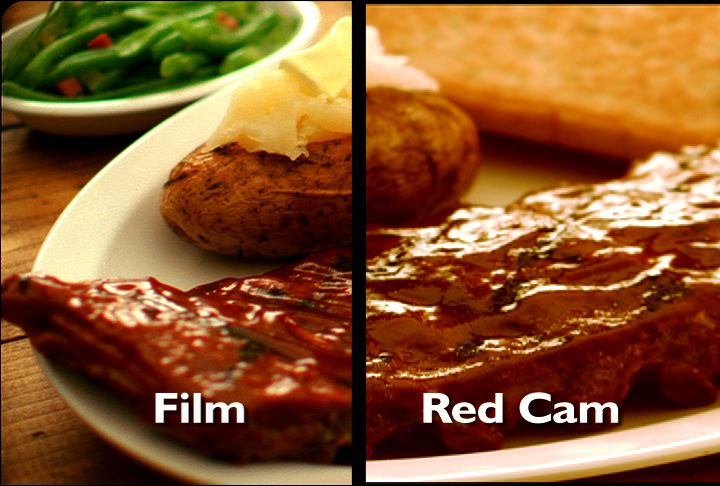
Without getting too mired in technical data, why not judge for yourself. Can you tell which was shot on film and which was shot digitally (Red Camera)? If you can’t … do you think you customers will?



 Posted by tvisnotdead


![1223614014164350284LlubNek_Closed_Envelope_1.svg.hi[1]](https://tvisnotdead.files.wordpress.com/2009/11/1223614014164350284llubnek_closed_envelope_1-svg-hi11.png?w=150 "1223614014164350284LlubNek_Closed_Envelope_1.svg.hi[1]")

 TV Is Not Dead