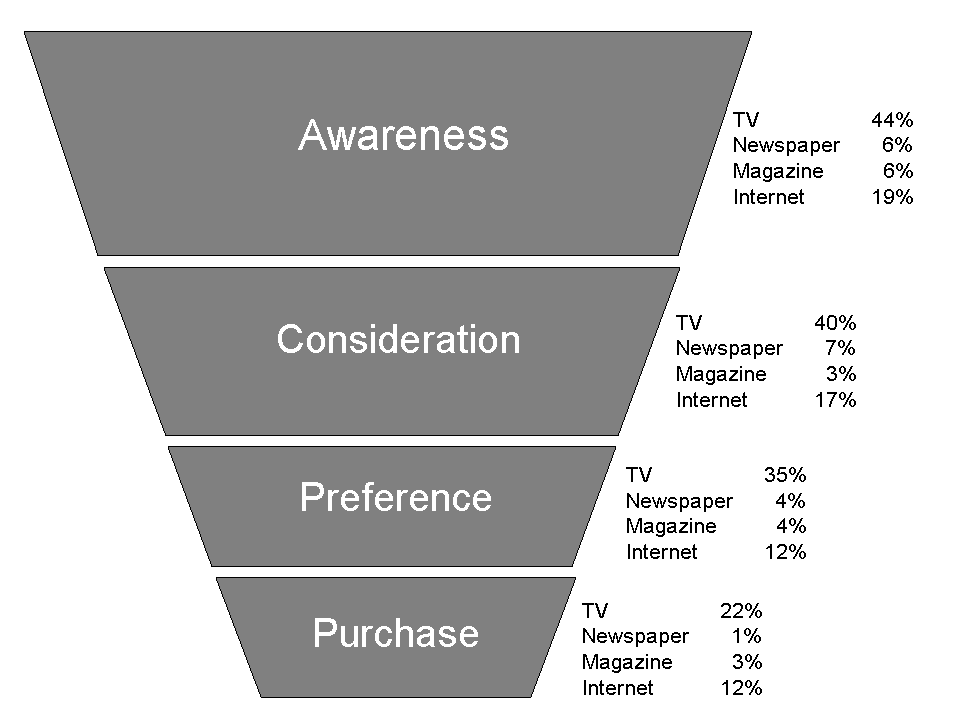
Question: “Which advertising media experience … most increased your awareness; most increased your level of interest; made you consider purchasing; encouraged you to actually purchase?”
What do Hyundai/Kia, Subaru and Volkswagen all have in common?
1) They spent considerably more on television advertising for the first 6 months of 2009, as a percentage of their ad budgets, than the auto industry average.
Brand
% of ad budget spent on TV Advertising
Hyundai/Kia
78.4%
Subaru
90.0%
Volkswagen
80.7%
Industry Avg.
62.5%
2) All three auto makers saw their market share increase substantially over the same period a year ago.
Brand
Market Share Increase
Hyundai/Kia
39.7%
Subaru
52.9%
Volkswagen
28.8%
3) All three posted year-over-year unit sales decreases (every single manufacturer suffered decreases in sales during this period) that were considerably less than the industry average.
Brand
Unit Sales Decreases
Hyundai/Kia
-9.4%
Subaru
-0.8%
Volkswagen
-16.4%
Industry Avg.
– 35.1%
4) All three brands allocated a smaller percentage of their ad budgets to Internet advertising than the industry average:
Brand
% of ad budget spent on U.S. Internet Advertising
Hyundai/Kia
3.7%
Subaru
5.4%
Volkswagen
4.0%
Industry Avg.
7.5%
What do I think?
First of all, I think all three auto makers have done a great job bringing products to market that people actually want to buy. That’s most important to remember.
I also think it’s hard to refute what the data above says about their advertising decisions. There’s no denying, I’ve seen a ton of compelling television commercials for Hyundai, Subaru and Volkswagen this past year … and it would appear I was not the only one.
I don’t care how the new media crowd spins it, when a brand like Subaru spends 90% of their total ad budget on television and is able to increase market share by 53% — it makes a compelling case for the power of television advertising. Short and simple.
And when you add in the impressive sales performances by Hyundai and Volkswagen, it’s even harder to ignore that television played more than just a casual role in success of all three auto makers. Wouldn’t you agree?
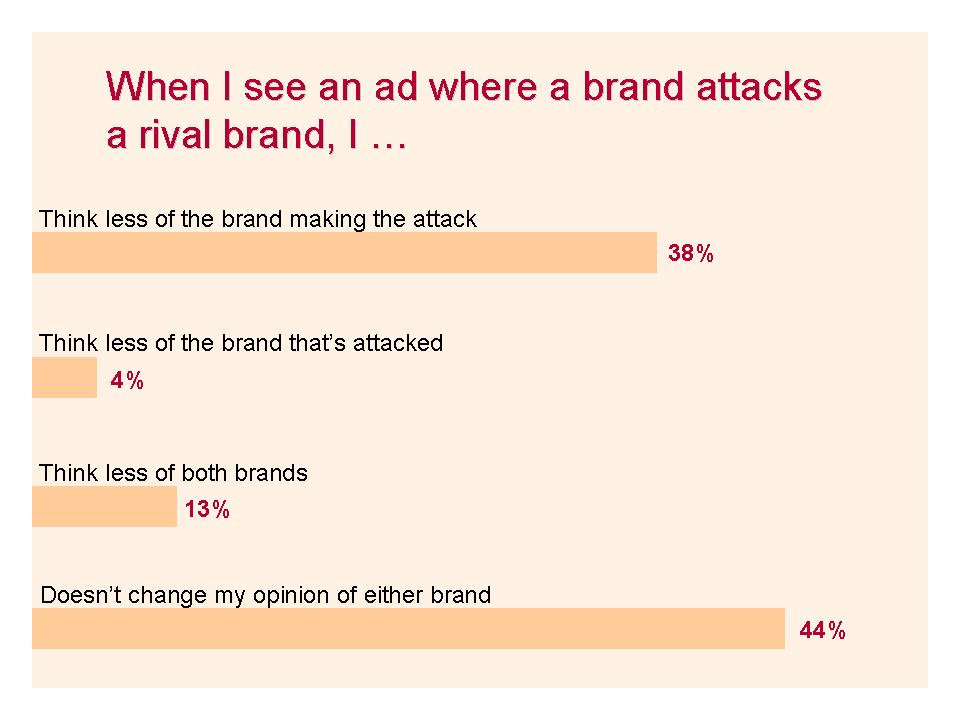
Compared to political campaign ads, retailers have been cautious about using negative TV ads to badmouth their competitors. A recent Adweek/Harris Poll indicates such caution is well founded.
As the chart shows, people have a predisposition to think worse of the brand making the attack than the brand that is the target.
One caveat: Though people routinely claim to dislike attack ads in politics, the results on Election Day often suggest those ads have worked. So, consumers may be less averse than they say to TV advertising that goes negative on the competition.
Arbitron continues to make progress in their effort to measure out-of-home television viewing. Pierre Bouvard, Arbitron’s Executive Vice President, says up to 35% of Americans are watching TV out-of-home, and stations aren’t getting credit for out-of-home viewing using the existing ratings system.
But, thanks to Portable People Meter (PPM) technology, TV networks and stations will soon be getting credit for total viewing, not just at-home viewing.
The PPM was developed by Arbitron to more accurately measure the number of people watching TV. The device is carried like a pager and picks up audio codes hidden within a station’s broadcast. So, it doesn’t rely on viewers to punch a button or write in a diary to record their viewing habits. The meter does all the work.
TBS (Turner Broadcasting) was the first client to sign with ARB-TV, and during the MLB Playoffs discovered the value of out-of-home audience measurement.
According to Arbitron, the out-of-home viewership of the baseball playoffs increased the total audience size by 27% for adults 25-54.
Sports fans in bars are just part of the story. When the PPM was tested in Houston, Arbitron noted significant out-of-home audiences in every demo daypart, including women 18-49 during daytime hours. During the test period, a 17% audience increase was reported for W18-49.
ARB-TV reveals the top places for out-of-home viewing are:
1) Friend’s House
2) Bars & Restaurants
3) At Work
The important thing to remember is that out-of-home TV viewership is not currently measured and not reflected in the ratings that stations provide their clients. From a media planning standpoint, that’s not good.
However, until there’s a new ratings system firmly in place to measure out-of-home viewership, retail advertisers will continue to reach viewers they’re not paying for … and in this economy, that’s not bad.
It seems that when it comes to high-stakes political campaigns, where every dollar has to count, politicians are still turning to what has always worked for them – television advertising.
Wells Fargo Senior Analyst, Marci Ryvicker predicts that $3.3 billion will be spent in political and issue advertising in 2010 – with 67% of every dollar spent going to television.
Here are her projections for the entire advertising industry for the 2010 Political season:
Let’s just cut to the chase? As it stands today, TV advertising builds brands. Internet advertising does not. There’s little doubt that once a brand is established, the Internet can and does keep the momentum moving forward, but until that point is reached all the banner ads and twitter tweets will do little to ingrain your brand into the psyche of the consumer.
Creating a memorable brand requires more than getting people to talk about your product on a social network. It requires the advertiser to make an emotional connection that television does so well. Do you honestly think Nike would be the #1 sports brand if it wasn’t for television advertising? Or would you feel the same connection with a little known insurance company if their AFLAC-ing duck never made its way onto your television screen?
Sure technology has changed, but the basic rules of effective marketing remain the same. You still need reach and frequency to create most truly memorable brands. And television advertising delivers both better than anything else out there.
Television has a rich history of transforming everyday companies into household names. From packaged goods to insurance, from fast food to tires – television has been responsible for creating some of the most memorable advertising icons.
Who can forget …
The Energizer Bunny … Frank Bartles and Ed Jaymes … Joe Isuzu … Tony The Tiger … The Michelin Man … Mr. Whipple … Dave Thomas … Mr. Peanut … The Keebler Elves … The Maytag Repairman … The Geico Gecko … Charlie The Tuna … Ronald McDonald … Mrs. Olsen … Jared from Subway … Clara “Where’s the Beef” Peller … Orville Redenbacher … The Marlboro Man …Colonel Sanders … Pillsbury Doughboy … Chef Boyardee … The AFLAC Duck … The California Raisins … Morris the Cat … The Quaker Oats Man … The Green Giant … Juan Valdez … The Doublemint Twins … The Budweiser Frogs … Rosie, The Bounty quicker picker upper … Aunt Jemima … Mr. Clean … The Verizon Wireless “Can You Hear Me Now” Man … Betty Crocker … The Lucky Charms Elf … The Geico Cavemen
Now, recall just one advertising icon or brand that wasn’t first introduced to you on television.
After a dismal 2009 for the ad industry, television should actually grow its overall share of the advertising revenue pie over the next couple of years. This coming from the ZenithOptimedia Groups report on the outlook on advertising in the U.S. marketplace.
According to the report, domestic ad spending in general will decline 12.9% this year and will erode another 4.4% in 2010. But prospects for TV are a lot more encouraging.
The agency expects television to return to growth next year. In 2009 it is expected to take 39.3% of all ad revenues and increase to 39.7% and 39.9% in 2010 and 2011, respectively.
So let me get this right, with all the advertising choices out there – traditional and digital – television’s share of the pie is getting bigger not smaller? How can this be?
The only explanation I can think of is that despite the talk of paradigm shifts and the world’s fascination with anything digital – there’s still enough advertisers, big and small, who are more persuaded by results than hype.
And at the end of the day folks – what else matters?
A new report by research Horowitz Associates, that surveyed 800 nationwide multichannel TV customers, reveals that only 2% (or two hours per month) of all TV viewing in the U.S. comes from non-traditional TV devices. That means that the majority of people still prefer watching their favorite
programs the good old fashion way.
According to Horowitz, the 2% represents two hours of the 130.2 overall hours that U.S. TV viewers watch in a month.
But when consumers do watch online, the #1 device for non-traditional TV viewing is the laptop. The top video viewing websites are:
YouTube
ABC.com
Hulu.com
NBC.com
The top types of programs watched on alternative video platforms are:
scripted dramas 24%
news programming 14%
comedy shows 13%
sports 13%
sitcoms 11%
Horowitz says that of those surveyed, over one-third (36%) wish all their favorite shows were available online; another 30% wish all TV shows were available on handheld devices.
A smaller number of TV viewers (7%) said that if all or most TV programs were available on their computer, they would get rid of their TV service.
The majority, however, still prefer traditional TV viewing. Eight in 10 (79%) say they prefer to watch TV shows on a TV versus a computer or handheld device.
Creativity in advertising should be anything but formulaic. A good idea, powerful visuals, a great voice over talent and a strong script will go a long way.
However, there’s something to be said for structure. Notice I said “structure” and not “formula.” The process demonstrated here shows how structuring the message can help viewers retain the message.
While this example shows the beginning, the middle, and the end of a retail TV commercial that communicates successfully, it’s important to note that variables can shift based on the complexity and amount of information.
1) Tell them what you’re going to tell them.
Start by telling your customers the “news.” If the commercial is about a special sale, tell them what it is. Better yet, find a hook people can remember.
EXAMPLE:
VO: At Florida Leather Gallery, think FREE times THREE! …
2) Tell them.
Now add the details. Reference any specific product shots, prices or particular offers. In this segment, the price/offer statement should be featured.
VO: … For a limited time, get free delivery, 2 full years free financing, and we’ll even pay your sales tax!
(Onscreen, a viewer sees graphics that coincide with the voice over and further support the offer):
1. FREE / Free delivery
2. FREE / Two years free financing
3. FREE / We’ll pay your sales tax
3) Tell them what you told them.
You’re running out of time, so focus on restating the sale name /hook/offer so they the main message stays with them.
VO: What are you waiting for! Think FREE, times THREE!
MUSIC/SINGER: Florida Leather Gallery!
A good structure will keep your message from getting confusing or convoluted. It’ll also keep you disciplined in making sure your message works within the small window of a 30-second TV commercial (or 15 seconds, as with the example above.)
You don’t need a big budget to have a big idea. In fact, lots of great TV commercials have been produced based on the merit of simple ideas.
Two or three years ago, Nissan did a TV campaign for its Z sports coupe using little more than dramatic, sepia tone still photography of the car in action. Viewers saw still shots of the car handling hairpin curves … smoking its tires on the pavement, etc. There was no script, only a powerful music track until the very end of the commercial where a single line of type appeared: “Words fail.”
Nissan could have spent seven figures on a single TV spot for its legendary Z, but instead, the agency chose to present a simple idea based on its own merits, rather than trying to hock an overly slick TV production. I seriously doubt that the goal was to save money. And I doubt the commercial was created for under $10K. But it’s a perfect example of still photography replacing an expensive motion picture shoot – successfully!
Still photography is a powerful tool. But there are more…
Take for example stock footage. If the core advertising message of a financial services firm is financial stability, consider dramatic footage of a full moon rising in the night sky and a voice over that says, earnestly and intimately: “Sleep well, even if the stock market goes bump in the night.”
True, using stock footage requires creativity. You have to find ways to adapt an idea or a message to something that already exists. But if done correctly, you’ll get a national looking campaign for a fraction of what it would normally cost.
Other inexpensive yet highly engaging spots use motion graphics, typography and witty writing to engage a viewer’s interest with the advertising message. A solid idea and a talented motion graphics editor can go a long, long way.
On the verge of exceeding your budget? Keep in mind, assets like custom jingle packages and animated logo treatments can be used again and again in future commercials, so there are major economies of scale working in your favor.
Even if you spend more than 10K for your first campaign, future campaigns may cost half that if you can reuse your most expensive elements.
Here, stock footage is used to promote a financial services firm. Our agency creative director produced this spot along with two others for $7,500.


 Posted by tvisnotdead




![1223614014164350284LlubNek_Closed_Envelope_1.svg.hi[1]](https://tvisnotdead.files.wordpress.com/2009/11/1223614014164350284llubnek_closed_envelope_1-svg-hi11.png?w=150 "1223614014164350284LlubNek_Closed_Envelope_1.svg.hi[1]")

 TV Is Not Dead