Using Retail TV Graphics Successfully: 5 Tips to Consider

September 18, 2009

Graphics are a great way of supporting your advertising message. But if they’re not handled carefully, they’ll hurt the clarity of your commercial rather than enhancing it. Here are a few things to consider when adding prices, offers and logos:

1) Consider Letterbox.

Traditional Letterbox (see example below) places your commercial between two black bands, much like the format of your favorite DVD when you watch it widescreen. This usually requires planning before the TV shoot so the picture is condensed to fit the Letterbox size.

This format is wonderful for showing detail within a scene (because you’re condensing the picture), but it’s also a GREAT tool for placing graphics. Addresses, logos and phone numbers work beautifully when placed in a Letterbox format, keeping such elements from dominating your footage.

2) Restrict your color palette.

Be careful you don’t use all the colors of the rainbow when creating your “supers” (another word for on-screen graphics). It’s good to have some color variation (usually two colors) to compartmentalize the information so it’s read easily. Too many colors confuses the eye and detracts from the footage within the commercial.

3) Place your graphics consistently.

Don’t confuse the viewer by jumping all around the screen. Place graphics so that they enhance the message and don’t distract from it.  If you have a series of graphic elements, consider keeping them in the same placement.

4) Consider instances where the graphics may be more important than the footage.

If the footage is more or less the same throughout (i.e. rows of used cars or a showroom of random pieces of furniture), there may be an opportunity to let the graphics play a more dominant role within the message. In cases like this when large prices may cover most of the screen, try defocusing your background to enhance readability.

5) Introduce type elements in an interesting way.

If the pace of your retail commercial is “urgent,” consider introducing your type onscreen using motion. Your TV editor can offer a variety of ways to do so. This little trick spices things up, giving the price/super a life of its own.

And now for my disclaimer: The key to using the list above is knowing what’s appropriate for your audience and making choices with great care. A used car commercial and a financial services commercial targeting seniors are two different animals. In one, moving type and interesting visual tricks can add excitement. In the other, unrestrained stylistic choices can cheapen the message and appear distasteful. Determine the right tone for your commercial, and let it be your guide.

Here’s a commercial for a local car dealer that demonstrates all of the above.  

Share


Retail TV and Your Website: Work Best When They Work Together

September 17, 2009

Picture for Post #24All too often I’m asked the question from retailers on where they should be investing their ad dollars:  TV or the Internet.  Folks this is not zero sum proposition.   If you’re not doing both – then you’re missing the boat.


 The formula for success is relatively simple, in my opinion:

  • Use TV advertising to engage, entice and persuade consumers to get more information about your product or service from your website. 
  • Once on your site, inform, educate and sell them on doing business with your company – either online or in person. 

Of course, if you’re product requires little explanation … then it’s plausible that prospects can and will respond to your TV offer with little need for a website visit.  But, don’t fool yourself, if you’re anything less than a household name (i.e. McDonald’s or Coke), potential customers will most likely want to check you out on the web before walking through your door.  And they better like what they see – within 5 seconds or they’ll exit your website immediately.

Believe it or not, even in the midst of today’s Internet explosion, there are still some retailers that don’t get it. I recently had a furniture store chain client whose only web presence was a simple splash page that included nothing more than store hours and addresses.  The client did not have a website.  And the really sad part – there was no hurry to get one.

The client’s explanation defied logic.  There was concern that people would judge the client by the website and then decide not to shop at the stores. No amount of pleading and prodding could convince the client to look at both the storefronts and website as one in the same.

Your company’s website should be a reflection of the experience customers get when they shop your stores.  It should be intuitive, interactive and INTERESTING. That’s the point my dear furniture retailer did not understand. 

A ton of TV spots won’t help if consumers become disenchanted when they land on your website.  

Despite the naysayers, people are still influenced by what they see on TV, but today they require more than just a 30-second commercial to help close the deal.  Make sure you’re giving it to them with an easy-to-navigate website that is more than an online company brochure. 

Remember:  “No media is an island.”


Share


TV Production Terms: Everything You Wanted to Know But Were Afraid to Ask.

September 15, 2009

Picture for Post #23Hang around on set during a TV production and you’ll likely scratch your head once or twice wondering what a “Best Boy” is. In TV, there are lots of unusual names for the people and things behind the scenes of each commercial being brought to life.

Having been on set hundreds of times, I often hear the same questions again and again from clients who are also attending the shoot. 

I’ve compiled a list of terms here:

DP: Director of Photography

AC: Assistant Camera

AD: Assistant Director / PA: Production Assistant

Gaffer: The chief lighting technician for a production who is in charge of the electrical department.

Key Grip: The chief grip who works directly with the gaffer in creating shadow effects for set lighting and who supervises camera cranes, dollies and other platforms or supporting structures according to the requirements of the director of photography.

Best Boy: The assistant chief lighting technician or the assistant to the key grip.

Slate: The identifier placed in front of the camera at beginning of a take.

Key Light: The main light on a subject. (Lighting)

Dolly Shot: Any shot made from a moving dolly. These may also be called tracking or traveling shots.

Pan: A horizontal movement of a camera on a fixed axis.

Gate: The aperture assembly at which the film is exposed in a camera, printer, or projector. This should always be checked before moving on to a new shot to make sure no hairs or dust particles got inside the camera. These things can ruin a shot.

Apple Box: A box built of a strong wood or plywood, which is capable of supporting weight. These may be of various sizes, the smallest of which is also known as a ‘pancake’ because it is nearly flat. (Lighting/Grip)

Rough cut: A preliminary trial stage in the process of editing a film. Shots are laid out in approximate relationship to an end product without detailed attention to the individual cutting points.

Food Stylist: An artist who works on set to perfect the look of food being shot.  This is a specialist, who concentrates on food preparation and presentation.

MOS: A term in TV commercials when you’re shooting subjects but not recording sound.

VO: Voice Over. The narrative voice you hear in TV spots.

Super: Refers to type on screen that supports a sales offer.

There you have it. Memorize these and you’ll impress everyone on set next time. Again, these are some of the most commonly terms used. If you’d like to learn oodles more – and by oodles I mean hundreds – click here: Filmland

Share


Giving Retail TV Commercials the “Film” Look Without the Film

September 14, 2009

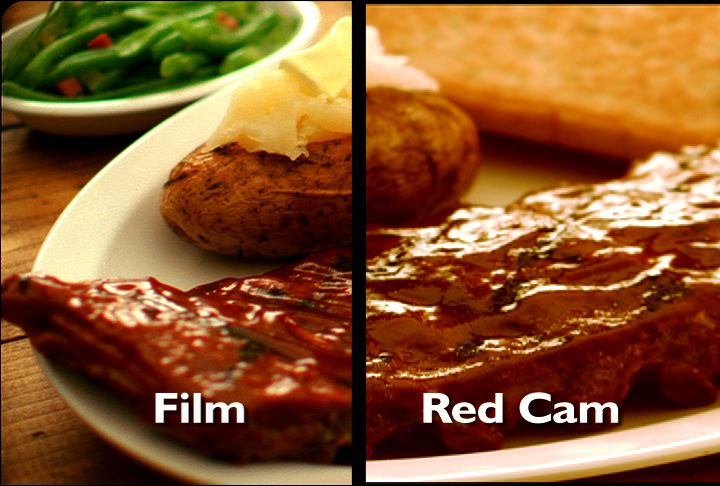
Companies who want their TV commercials to look national often hone in on the “look.” And the biggest commonality among commercials produced by major brands comes down to a four-letter word: FILM.

Major advertisers overwhelmingly choose film for their commercials for all kinds of reasons. Ask the country’s top commercial film directors and they’ll go on and on. Film has warmth. Film makes ideas seem more credible. Film makes a commercial seem more important to the viewer. Film provides a glow and softness that makes the viewer forget that there’s a camera and crew in the room.

Problem is, not everybody can afford to shoot on 35 mm film or even 16 mm film. Fortunately, there are viable options that didn’t exist a few years ago.

First up is the Veracam, a video camera that simulates the look of film. This one has been around and works beautifully.

Another option is the “Red” – one of the newest cameras on the market. This camera is entirely digital and simulates the look of film. And many say it’s the best at doing so. 

The Red also comes with another plus. Because it shoots everything digitally – and at a VERY high degree of quality – the images can be used in print applications like ads and brochures. (Do that with film and everything’s fuzzy.)

In both the Veracam and the Red, there is no film stock to buy…and no expensive telecine lab needed for color correcting. However, final shots selected for your commercial will still need color correction, which can be done easily by the editor or the director.

Without getting too mired in technical data, why not judge for yourself.  Can you tell which was shot on film and which was shot digitally (Red Camera)?  If you can’t … do you think you customers will?  

Picture for Post #22

Share


Three Stages in the Life of a Retail TV Commercial

September 11, 2009

If you’re wondering why it takes longer to produce some TV commercials Picture for Post #21than others, it helps to know some of the nitty-gritty “behind the scenes” stuff.

There are usually three stages in the life of a retail TV spot:

1) Pre-production

2) Production

3) Post-production

And the level of complexity in each varies greatly. While EVERY production is unique, the following offers a brief glance at the kinds of things that happen in each stage:

Pre-production

In this stage, it’s all about planning, planning, planning.

The production company (and sometimes the ad agency creative staff) meet with all the venders needed prior to get the ball rolling.

  • Timelines and budgets are finalized
  • Prop people get the proper specs so they can gather everything needed to stage the set appropriately
  • Castings are held to choose the right actors
  • A wardrobe specialist is consulted so the appropriate attire and accessories (and sizes) can be gathered for the actors
  • A location scout is sent to find an ideal place to hold the shoot (if it’s not in a studio).
  • If a custom music score is being written, the composer is briefed during this stage so that the music fits appropriately with the creative vision and is ready in time for Post Production.
  • If animation is being used, animators may begin their work, sometimes showing up on the shoot day to take proper lighting measurements depending on the animator’s needs.

All the while, the agency’s creative director and the commercial’s film director will collaborate closely to supervise and ensure a unified vision.  Prior to the shoot, the film director will compile a shot list so everyone is on the same page come shooting day.

Production

This is where the film director, creative director and film crew come together to bring the storyboard (the script and accompanying visuals that were used to explain the idea) to life.

Sets are constructed. Actors arrive.  Scenes are carefully lit. Performances are tweaked. And because every moment counts, a detailed shot list and schedule keeps everything on track. Subsequently, a composer may now be elsewhere working on a custom music track, and animators may be on set taking lighting measurements (or at their studio bringing additional components to your TV commercial to life.)

Post-production

If you’re shooting on film, this process begins in a telecine lab where the film is color corrected. From there it goes on to editing where the shots are laid out and the commercial gets its rough shape (called a rough cut). Often, any animation will also be added into the commercial during this process.

Then it’s off to sound design where the voice over is recorded and the music (stock or original) is added in along with any sound effects. Then it’s back to editing where everything gets married together.

It isn’t always this intense. In a “graphics commercial” with little more than price supers and still photos, it may be a simple matter of the ad agency giving definitive direction (and a tool kit) to the edit house along with a voice over and music track.

But don’t be fooled. Even the smallest of projects require thorough planning.

Share


Yes, Retail TV Commercials CAN Be Creative

September 9, 2009

I’ve said it before and I’ll say it again. The problem with a lot of TV commercials is that the offer is buried. All joke, and little homage paid to the offer. But let’s examine the flip side. A TV commercial that simply beats the consumer over the head with an offer does a poor job of engaging a viewer’s interest.

Let’s be honest, nobody watches TV looking for ads, if you can’t engage the viewer’s interest, your message will fall on def ears.

Therein lies advertising’s oldest challenge. How do you capture your consumer’s interest AND get them to listen to your sales message? The world famous Young & Rubicam advertising agency put it beautifully when they described their definition of the word Impact: anything that enlivens a customer’s mind to receive a sales message.

Sounds extremely simple, but the process can be extremely difficult. Fortunately, your starting place is always the same. Find the connection between your offer and the consumer’s motivation to act on it. Then, and only then, can you start getting “creative.”

If it’s a price discount, maybe there’s an interesting way to make “price” the creative idea within the commercial. Here’s an example: a barbecue restaurant is selling all-you-can-eat chicken for $6 instead of $9. In the commercial, a sculpted sign is dropped down over a plate of mouth-watering chicken. As the voice over makes the big price drop announcement, a hand dramatically turns the $9 into a $6. Yes, the offer is front and center, but the idea combines the incentive with the “creative aha moment” viewers want.

CAPTION: Who said price and item advertising can’t be creative. Here, the price discount was big news – and thus the central idea within the commercial.

What’s your message? Convenience? Superior service? Value? Authenticity? Once you’ve boiled it down, think of what it means to your customer. And then find the most dramatic way of making your point – without straying off message. The result will be a commercial people remember, and an offer that consumers are motivated to act on.

Share


Create a National Looking Retail TV Commercial for Under 10K

September 8, 2009


You don’t need a big budget to have a big idea. In fact, lots of great TV commercials have been produced based on the merit of simple ideas.

Two or three years ago, Nissan did a TV campaign for its Z sports coupe using little more than dramatic, sepia tone still photography of the car in action. Viewers saw still shots of the car handling hairpin curves … smoking its tires on the pavement, etc.  There was no script, only a powerful music track until the very end of the commercial where a single line of type appeared: “Words fail.”

Nissan could have spent seven figures on a single TV spot for its legendary Z, but instead, the agency chose to present a simple idea based on its own merits, rather than trying to hock an overly slick TV production. I seriously doubt that the goal was to save money. And I doubt the commercial was created for under $10K. But it’s a perfect example of still photography replacing an expensive motion picture shoot – successfully!

Still photography is a powerful tool.  But there are more…

Take for example stock footage. If the core advertising message of a financial services firm is financial stability, consider dramatic footage of a full moon rising in the night sky and a voice over that says, earnestly and intimately: “Sleep well, even if the stock market goes bump in the night.”

True, using stock footage requires creativity. You have to find ways to adapt an idea or a message to something that already exists. But if done correctly, you’ll get a national looking campaign for a fraction of what it would normally cost. 

Other inexpensive yet highly engaging spots use motion graphics, typography and witty writing to engage a viewer’s interest with the advertising message.  A solid idea and a talented motion graphics editor can go a long, long way.

On the verge of exceeding your budget? Keep in mind, assets like custom jingle packages and animated logo treatments can be used again and again in future commercials, so there are major economies of scale working in your favor.

Even if you spend more than 10K for your first campaign, future campaigns may cost half that if you can reuse your most expensive elements. 

Here, stock footage is used to promote a financial services firm. Our agency creative director produced this spot along with two others for $7,500.


Share


The Retailers’ Guide to TV Media Buying Terms

September 3, 2009

Picture for Post #18If you find yourself glazing over every time your ad agency or TV rep starts talking about cost per points or PUT levels, then I have the perfect remedy.   

Just click on the link for a comprehensive glossary of over 150 retail TV advertising terms and definitions.

Glossary of Television

So the next time they start laying on thick with the TV media buying jargon – you’ll be more than able to hold your own.

Remember:  Knowledge is power.

Enjoy.


Share


Retail Advertising: The Worst TV Commercial I’ve Ever Seen in Years!

September 1, 2009

The 60 second commercial you’re about to see, really highlights all that’s wrong with today’s retail TV advertising.  

See if you agree me …

So what did you think?  Bears and humans reversing roles … Pretty clever, huh?  And funny as all get out.  And what about the way it was shot?  The camera moves were exceptional.  Watch this commercial just once and you’ll remember it.  You might even tell a friend about it.

You:  “Hey, Bob … did you see that commercial with the bear carrying the golf club?”

Friend:  “Yeah … how did they do that?  Those bear costumes were so real looking!”

You:  “The Company must have spent a fortune on it.” 

Friend:  “No doubt.  Did you catch who it was for?”

You:  (Long pause) Something to do with barbeque, right?

Friend:  I think so?

You:  Oh well, I’ll have to pay closer attention next time.   

By-the-way, in case you missed it (And it would be easy to do, since the product was never mentioned in the audio and visually appeared on the screen for just under 4 seconds), the spot titled “Bears” was for Lloyd’s Barbeque Ribs

O.K. Forget about the bears and the fact you can only sorta, kinda, maybe, remember the product.  Did you find your mouth watering after watching the spot?

If you were like me, you always crave food right after watching sloppy, disheveled looking people eat off a dirty kitchen floor. 

And did you like food photography.  Brief but exquisite, wasn’t it.  You remember it, don’t you? The 2 second shot of what I think were cold ribs, sitting on a plate next to an unidentifiable side dish.

Oh well, you gotta cut corners somewhere.  Big time directors don’t come cheap. And food stylists are overrated.  After all, everyone knows what ribs are supposed to look like … but a bear wielding a golf club – now that’s pure entertainment!

Joking aside, this commercial is embarrassing for anyone who has ever made an “honest” living creating retail advertising.   

This mess is what happens when ad agencies are more interested in making movies than moving products.

If this is what the agency for Lloyd’s thinks is good retail advertising, I have a suggestion for them.  Let the bears produce the next commercial … it couldn’t be any worse.

Share


Retail TV Advertising in Local Newscasts is More Engaging

August 28, 2009

TV commercials that appear in local newscasts are the most engaging, Picture for Post #15according to a recent study conducted for Hearst-Argyle Television by researcher Frank N. Magid Associates.

Speaking at the annual Association of National Advertisers (ANA) Conference in New York, Hearst-Argyle CEO David Barrett pointed out that local TV newscasts are more “DVR proof” than other broadcasts because viewers tend to watch the local news live and therefore are not as likely to fast forward through the commercials.

The study also found that viewers were more engaged with ads in local newscasts than with radio (72% compared to 28%) newspaper (64% compared to 36%), direct mail (55% to 45%) and magazines (57% versus 43%).  

Survey results also showed that 47% of the 2,500 respondents said local TV news was “my most important source of information in my community.” That figure was the same for newspaper, but topped Web sites (30%) and radio (17%).

Hearst-Argyle operates 29 TV stations from coast to coast, reaching 18% of U.S. Homes.


Share